Author: sunnylcw
-
Blurring boundaries: The intersection of music, AI, and new media
Blurring boundaries: The intersection of music, AI, and new media
-
VR Film Scholar Seminar: Exploring Creative Work in Filmmaking at a Research University
VR Film Scholar Seminar: Exploring Creative Work in Filmmaking at a Research University
- February 12, 2025
Moderator: Tim Gruenewald
February 12, 2025
RRST – 5.41
10:30 AMWe will discuss two of Professor Kath Dooley’s recent publications and explore the challenges and opportunities of pursuing creative work at a research university. Please read the following two papers before the seminar:
- Dooley, Kath, Stayci Taylor, and Craig Batty. “Crafting Immersive Experiences: A Case Study of the Development of Three Short Narrative Cinematic Virtual Reality (CVR) Projects.” The Palgrave Handbook of Script Development. Switzerland: Springer International Publishing AG, 2021. Pages 503–515. Available at HKU library.
- Dooley, K. (2024). Virtual Reality Narration: Listening to and Reliving Stories Through First-Person Testimony. In: Virtual Reality Narratives. Palgrave Macmillan, Cham. Available at https://doi.org/10.1007/978-3-031-64965-3_3.
Kindly register here (HKU Portal login required), or email Stephanie Wong (swsswong at hku.hk).
-
eXtended Humanities Lecture Series: Writing for the Spectator on the Stage: Approaches to VR Storytelling
eXtended Humanities Lecture Series: Writing for the Spectator on the Stage: Approaches to VR Storytelling
- February 12, 2025
February 12, 2025
CRT – 4.36
4:30 PM
ZOOM LINKAbstract:
In recent years, virtual reality has been embraced by storytellers working in fiction, and/or documentary realms to create memorable, immersive experiences. Viewed through head mounted display (HMD) goggles, a VR story world is spherical in nature, unfolding in 360-degrees around the spectator who experiences a sense of presence in the world. This phenomenon, which is fostered by VR technology, transforms story into simulation for a viewer who may be able to directly interact with characters or objects.
Noting the experiential nature of VR projects, this presentation seeks to explore the storytelling techniques, structures and approaches to narration that contemporary works adopt. It will focus on ‘environmental storytelling’ (Carson 2000; Jenkins 2004) a concept drawn from theme park and video game discourse, discussing how this is evident in a range of recent case studies. Specifically, the presentation will consider how VR stories allow users to ‘enact narrative’ and/or how narrative may be drawn from objects that are discovered by the user. These environmental storytelling techniques will be interrogated alongside narrative strategies that are commonly utilised in VR, such as the use of voice over or direct address to the spectator, to question the specificity of storytelling in this interactive medium.
Speaker’s Bio:
Associate Professor Kath Dooley is a writer/director and academic based at the University of South Australia. Her creative work has screened at events such the Busan International Short Film Festival and the International Festival of Virtual and Augmented Reality Stories (FIVARS), Toronto. Kath is author of Virtual Reality Narratives: Embodied Encounters in Space (Palgrave Macmillan, 2024), Cinematic Virtual Reality- A Critical Study of 21st Century Approaches and Practices (Palgrave Macmillan, 2021) and co-editor of Screenwriting for Virtual Reality (Palgrave Macmillan, 2024). Her research interests include embodiment in the context of screen media, virtual reality and screenwriting, women’s screen industry practice, and diversity in the screen industries.
-
VR Filmmaking Workshop with Kath Dooley
VR Filmmaking Workshop with Kath Dooley
- February 11, 2025
February 11, 2025
RRST – Arts Tech Lab
4:30 PMRegistration required.
In this workshop, we will view and discuss two VR documentary films by Professor Kath Dooley: Inside Earthship Freo (2019) and Impact: Beyond the Night Sky (2020). Together with the filmmaker, we will explore the process of writing and directing for VR at the example of the two films. We will also look into the technical aspects of VR filmmaking and challenges and opportunities of distribution.
Speaker’s Bio:
Associate Professor Kath Dooley is a writer/director and academic based at the University of South Australia. Her creative work has screened at events such the Busan International Short Film Festival and the International Festival of Virtual and Augmented Reality Stories (FIVARS), Toronto. Kath is author of Virtual Reality Narratives: Embodied Encounters in Space (Palgrave Macmillan, 2024), Cinematic Virtual Reality- A Critical Study of 21st Century Approaches and Practices (Palgrave Macmillan, 2021) and co-editor of Screenwriting for Virtual Reality (Palgrave Macmillan, 2024). Her research interests include embodiment in the context of screen media, virtual reality and screenwriting, women’s screen industry practice, and diversity in the screen industries.
-
Innovating Archaeology: HKU Scholars Utilise Immersive 3D Tech to Document and Study the Human Past
Innovating Archaeology: HKU Scholars Utilise Immersive 3D Tech to Document and Study the Human Past
- November 21, 2024
Archaeologists from the Faculty of Arts at the University of Hong Kong (HKU) are revolutionising the excavation and documentation of ancient sites with cutting-edge 3D immersive technologies.
Archaeology studies the human past through the excavation of things people made and used thousands of years ago – from architecture to objects like pottery bowls and animal bones from meals. Although many excavation projects create digital 3D models of what they uncover, archaeologists need new ways to meaningfully use those data. Some projects share 3D models with the public as tourism and teaching tools – one may have recently seen 3D displays at museums. However, archaeologists themselves have not yet taken full advantage of these models in their own fieldwork and research. That is about to change!
By wearing Mixed and Augmented Reality (MR/AR) headsets while actively digging, the HKU team is pioneering the interactive application of digital 3D scientific data at archaeological sites. MR headsets enable users to effortlessly view and interact with both the real world and 3D models integrated within it, using devices such as the Microsoft HoloLens 2 and the Meta Quest Pro. On the other hand, AR smart glasses display information on a small screen within the lenses and are equipped with cameras and microphones for hands-free data collection.
These technologies play a crucial role in the field of archaeology, often regarded as a ‘destructive science’, where data collection involves the excavation and removal of artifacts, preventing anyone else from digging the same place again.
The HKU team innovatively applied the technologies in their fieldwork project in the South Caucasus country of Armenia, where the team often removes ancient stone walls and pottery vessels to uncover earlier remains beneath. Professor Peter J. Cobb, an archaeologist at the HKU Faculty of Arts, emphasised the benefits of the new technology, stating: “By wearing an MR device while I dig, I can virtually see a removed wall at its original location. This helps me decide where to dig next, and I can compare, in situ, multiple sections of ancient architecture that were removed at different times.”
Additionally, the team uses AR smart glasses for basic data recording such as capturing photographs and using voice recognition for notetaking. Professor Cobb pointed out that “Archaeologists must have their hands free while recording data, since we need to hold our trowels and brushes while digging.”
HKU Faculty of Arts PhD candidate Mr Hayk Azizbekyan, who leads this research and is from Armenia himself, explained: “MR and AR headsets have never been used before at an actual archaeological excavation project to support the digging work of a team, this is our game-changing innovation! I’m excited to experiment with future ways of studying old things and preserving cultural heritage. We call this project our ‘vision for the future’, since the technology enables new ways of ‘viewing’ the past’”.
The team also employs an MR headset to compare 3D scanned ancient pottery sherds with physical ones, aiding in the analysis of inaccessible artifacts displayed in museums. They anticipate that in the future, AI will facilitate the matching of these sherds based on their shapes.
These groundbreaking achievements were recently published in the Journal of Computer Applications in Archaeology (JCAA), ranked 8th out of over 350 archaeology journals in the world, by Scopus.
Professor Cobb noted: “It was interesting, the journal faced a challenge finding peer reviewers since our approach was so novel.” He also led a discussion on these innovations at the Institute for the Study of the Ancient World (ISAW) of New York University (NYU) on November 13, 2024.
This interdisciplinary research collaboration bridges the gap between humanities and engineering, driven by the team’s passion for advancing the field of archaeology through a unique Arts-Tech partnership with HKU engineers. The Tam Wing Fan Innovation Wing of the HKU Faculty of Engineering provided equipment and know-how. Recognizing the limitations of existing MR/AR headsets, the interdisciplinary team is now developing custom smart glasses for future fieldwork seasons.
About the Ararat Plain Southeast Archaeological Project (APSAP)
Technological experimentation is central to HKU’s fieldwork project in Armenia, conducted in collaboration with the Institute of Archaeology and Ethnography, National Academy of Sciences, Republic of Armenia (IAE, NAS, RA). APSAP researches the Vedi River Valley of Armenia, situated within the Ancient Near East – the area of the world that saw the first agriculture, states, cities, and writing. APSAP excavates the 3500-year-old Vedi Fortress and deploys advanced technologies to discover new archaeological sites. In support of APSAP’s advanced digital documentation efforts, HKU Faculty of Architecture Professor Guillaume Othenin-Girard has designed an innovative laboratory building, which he describes as “integrating the requirements of cutting-edge recording technologies with the historical architectural heritage of Armenia”. APSAP also offers a unique educational opportunity for HKU students to travel to the South Caucasus, earning academic credit from an HKU course that is the subject of pioneering educational research by Professor Juuso H. Nieminen of HKU’s Faculty of Education.To view the article from the open access Journal of Computer Applications in Archaeology (JCAA): https://doi.org/10.5334/jcaa.140.
To view a video, produced by the HKU Knowledge Exchange Office, about the APSAP project’s work with 3D archaeology, architectural innovation, and educational research: https://youtu.be/YMKJR1b94Z4
For media enquiries, please contact Professor Peter J. Cobb, School of Humanities, Faculty of Arts, HKU (E-mail: pcobb@hku.hk).
-
Workshop: Using Virtual Reality for Teaching and Learning
Workshop: Using Virtual Reality for Teaching and Learning
- November 18, 2024
Since the arrival of consumer grade virtual reality (VR) technology around 2015, VR has emerged as a new narrative medium. This workshop introduces how narrative VR can be used for teaching and learning in the humanities. We will begin with a brief introduction to modern VR technology and VR film. Drawing on a virtual field trip to the United States and two introductory courses taught at HKU, I will provide examples of how I used VR as a complementary tool to teach history and contemporary social issues in the United States. All participants will receive a VR headset to experience all VR films discussed in the workshop. Finally, we will consider best practices of u sing VR for teaching and learning and look at an example of a VR exhibition that wascreated as a student assignment in a recent course. Participation is limited by the number of VR headsets.
– Tim Gruenewald
-
MA in Art History 2025-2026 is now OPEN for application
MA in Art History 2025-2026 is now OPEN for application
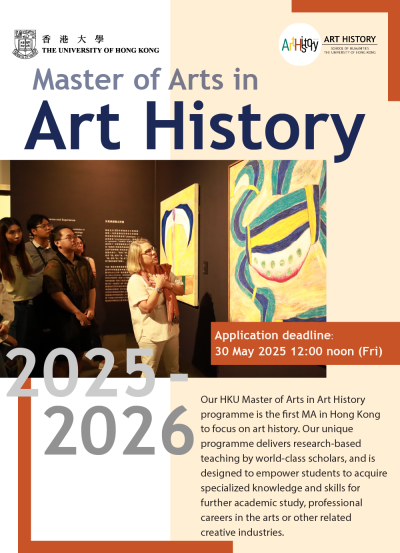
HKU is the first university in Hong Kong to offer a Master of Arts in Art History. Our unique programme delivers research-based teaching by world-class scholars, and is designed to empower students to acquire specialized knowledge and skills for further academic study, professional careers in the arts or other related creative industries.
To apply, please click here.
-
The interaction between Japanese and German music theory around Hugo Riemann
The interaction between Japanese and German music theory around Hugo Riemann
-
New Book: Virtual Reality Narratives
New Book: Virtual Reality Narratives
- September 15, 2024
Senior Research Affiliate Kath Dooley just published her second monograph on VR narratives: Virtual Reality Narratives: Embodied Encounters in Space (Palgrave Macmillan)It delves into recent evolutions in virtual reality (VR) storytelling, focusing on entertainment-based works created or launched since 2020. Through various case studies, it showcases the increasing diversity and sophistication of recent narrative-based projects. Moving past the initial hype associated with the latest wave of VR, a number of innovative and affective works combining documentary-based or fictional storytelling with game mechanics, live theatre and other elements, have appeared at festivals or on distribution platforms in recent years. These interdisciplinary works have much to tell us about the future of VR storytelling but have yet to receive sustained analysis. This book aims to correct that.
Dooley argues that VR, as an interactive medium that places the user inside a storyworld in a visible or invisible virtual body, offers narratives that incorporate the user’s body as a storytelling tool. This fosters user-centred stories that unfold in three-dimensional space. Adopting phenomenological and formal analysis methodologies, the monograph examines case studies through their approaches to narrative, style, and interactive devices. Key concepts that are explored include agency, direct address, environmental and spatial storytelling, embodiment and presence. By providing a much-needed analysis of works through a variety of theoretical lenses, the book illustrates how recent VR storytelling fosters powerfully transformative experiences.
Buy E-book here.